goes
on
here?
-
About
our
church
About our church
We are Kingston United Reformed Church, established in Kingston in 1673 as a Presbyterian Church and becoming a Congregational Church on our current site in 1775.
In 1972 the Congregational Church united with the Presbyterian Church at a national level to become the United Reformed Church. Our aims are to serve the people of Kingston as a church, and to open our adjacent 19-room Richard Mayo Centre to as many community groups and individuals as possible.
In 2005, we completed major work to the church (roof repairs and re-decoration) and to the Richard Mayo Centre (installing a lift and a state-of-the-art Training Room, modernising the Foyer and re-modelling other rooms).
Our own fundraising activities and donations raised over £200,000, and Trusts donated the remainder of the money needed.
2012: On Friday 5th October the 40th anniversary of the almalgamation of the English and Welsh Congregational churches with the English Presbyterian churches to form the URC was marked. This union of the separate denominations was the first since the Reformation. -
Church
covenant
The Church Covenant
We, the members of this Church, acknowledge God to be our Heavenly Father, and Jesus Christ His Son to be our Lord and Saviour.
We commit ourselves above all to God and to one another; to live in the unity of the Holy Spirit and in the order and love of a Christian Church.
 We affirm our desire to follow the example and teaching of our Lord Jesus Christ, by the guidance of His Spirit; and to witness to His love, and serve His world, by the consecration of our talents, time and means.
We acknowledge our Church to be part of the United Reformed Church; to be in a Local Ecumenical Covenant with All Saints Church, and, by God's grace, we seek fellowship with all other Christian Churches, praying and working unity throughout the world. -
The United
Reformed
Church
The United Reformed Church
What is special about the United Reformed Church?
- We are part of God's great world church - an energetic, passionate part;
- Passionate about: justice and peace; combating racism; and about relieving poverty;
- Proud that we were the first to ordain women;
- Eager to hear the God who still speaks to us.
- We believe in the Trinity
- We believe God can use us all. We take most big decisions locally; every church member can have a say.
- We have roots in history. We were part of the great reform movement which spread worldwide, but we want God to use us today.
- We have a hundred thousand people in 1600 congregations across England, Scotland and Wales, bringing together former Presbyterians, Congregationalists and members of the Churches of Christ.
- We long for unity with Christians of other traditions too.
That's us. The United Reformed Church
Kingston URC is in the Wimbledon and District Area Co-ordination Team (ACT), and the Southern Synod of the URC
Find out more about the United Reformed Church in the UK. -
How our
church
works
How our church works
Kingston United Reformed Church has around 200 members, led by our Ministers supported by a Personal Assistant and an advisory group of between 12 and 16 Elders. Elders have a wide remit to oversee KURC procedures, organisations, finances and buildings as well as to foster concerns in the congregation for outreach and the wider responsibilities of the church.
Nominated and elected by all church members at an annual election, Elders are appointed for a three-year period and may also serve for a continuous period of six years service after which they are required to stand down for at least one year before re-election. All church members are eligible to serve as an Elder.
The decision-making body of KURC is the Church Meeting which is held every two months and where all members have an equal vote.
Various committees run the many activities of the church, all of which are staffed on a voluntary basis by church members. We have a full-time Children, Youth and Families Worker. The Premises Manager is also a paid member of staff. -
Church
links
Church links
-


In 1971 KURC became a member of a Local Ecumenical Partnership (LEP) in Kingston Town Centre in partnership, with All Saints Church and Kingston Baptist Church (now closed). Also represented are: St John the Evangelist, Grove Lane; John Bunyan Baptist Church (now closed), Kingston Quaker Meeting and Kingston University Chaplaincy. The partnership was formally established as a Local Ecumenical Project in May 1991, in which the represented churches undertook 'not to do anything separately that ought to be done together.'
[Full resolution image of the LEP Covenant] -
KCT (formerly Churches Together in Kingston) makes it easier for local churches to work together, to keep in touch with each other and to share information about events at other churches such as the Good Friday Reflection, Night Shelter, Street Pastors, University and College Freshers' Fairs. The KCT Newsletter is published three times a year. KCT supports Kingston Churches Housing Association (KCHA), Kingston Churches Action on Homelessness (KCAH), Oxygen, Street Pastors, Christian Aid Week, and Fairtrade.
Contact:Teresa James - Secretary, KCT, c/o Kingston URC
The Local Ecumenical Partnership (LEP)
Kingston Churches Together (KCT)
-
In 1971 KURC became a member of a Local Ecumenical Partnership (LEP) in Kingston Town Centre in partnership, with All Saints Church and Kingston Baptist Church (now closed). Also represented are: St John the Evangelist, Grove Lane; John Bunyan Baptist Church (now closed), Kingston Quaker Meeting and Kingston University Chaplaincy. The partnership was formally established as a Local Ecumenical Project in May 1991, in which the represented churches undertook 'not to do anything separately that ought to be done together.'
-
History
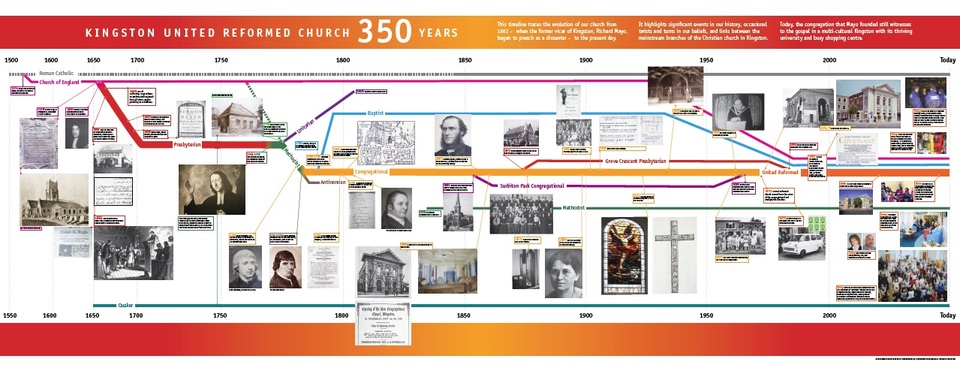
(The Timeline mural shown above can be seen in the Meeting Room of the Richard Mayo Centre.)
History
This brief timeline of Kingston URC has been provided by John Fisher who is our Church Archivist and also a church member. He has minute books, magazines, cuttings and photos, and will gladly supply any historical information you might need.
- 1662 - Richard Mayo is Vicar of All Saints Church, Kingston. A Presbyterian, who had been installed during the time of Cromwell, he refused to comply with the new Act of Uniformity which required every Parish Priest to assent to everything in the Book of Common Prayer. He was ejected and gathered around him a like-minded group of people (Dissenters) who worshipped in secret at places such as Down Hall (near the present day Bentall's Car Park).
- 1689 - The Toleration Act allowed this congregation to build a meeting house, near Bath Passage. It was run on Presbyterian lines. Membership by 1703 was 100.
- 1750 - This was a period of turmoil and uncertainty as the congregation leant towards Unitarian beliefs.
- 1775 - The Congregational/Methodists split from the Presbyterian/Unitarians, moving to a building on the present church site and drawing up a covenant on Congregational lines. (See more detail from June 2012 Church News.)
- 1787 - Some members left to found Kingston Baptist Church.
- 1793 - William Ranyard, a Congregationalist, founded the 'Kingston Sunday Schools', with donations from the local community.
- 1799 - A new covenant was signed, ending: 'We desire and earnestly pray to be enabled through grace uniformly to take the unerring word of God for our rule, and the spirit of God for our guide in all things'.
- 1803 - The Independent Congregationalists built a small church close to our present site, costing £100. There were 50 members, and sermons lasted 'about an hour'.
- 1817 - 70 boys and 60 girls attended the Sunday School.
- 1822 - The first musical accompaniment in church: a bass viol.
- 1850 - The minister's salary was met by pew rents of £250 per year, and the upkeep of the building from weekly gifts totalling £90 per year. There were scores of new members under the new minister, Lawrence Byrnes.
- 1856 - Our current church building was erected in 9 months, costing £4000.
- 1870 - A choir was mentioned for the first time.
- 1871 - The organ was built for £350.
- 1880 - The Band of Hope (a temperance organisation) was formed.
- 1896 - 14 paid choirboys caused so much trouble that their services were dispensed with.
- 1906 - Boys' Brigade and Women's Guild were formed.
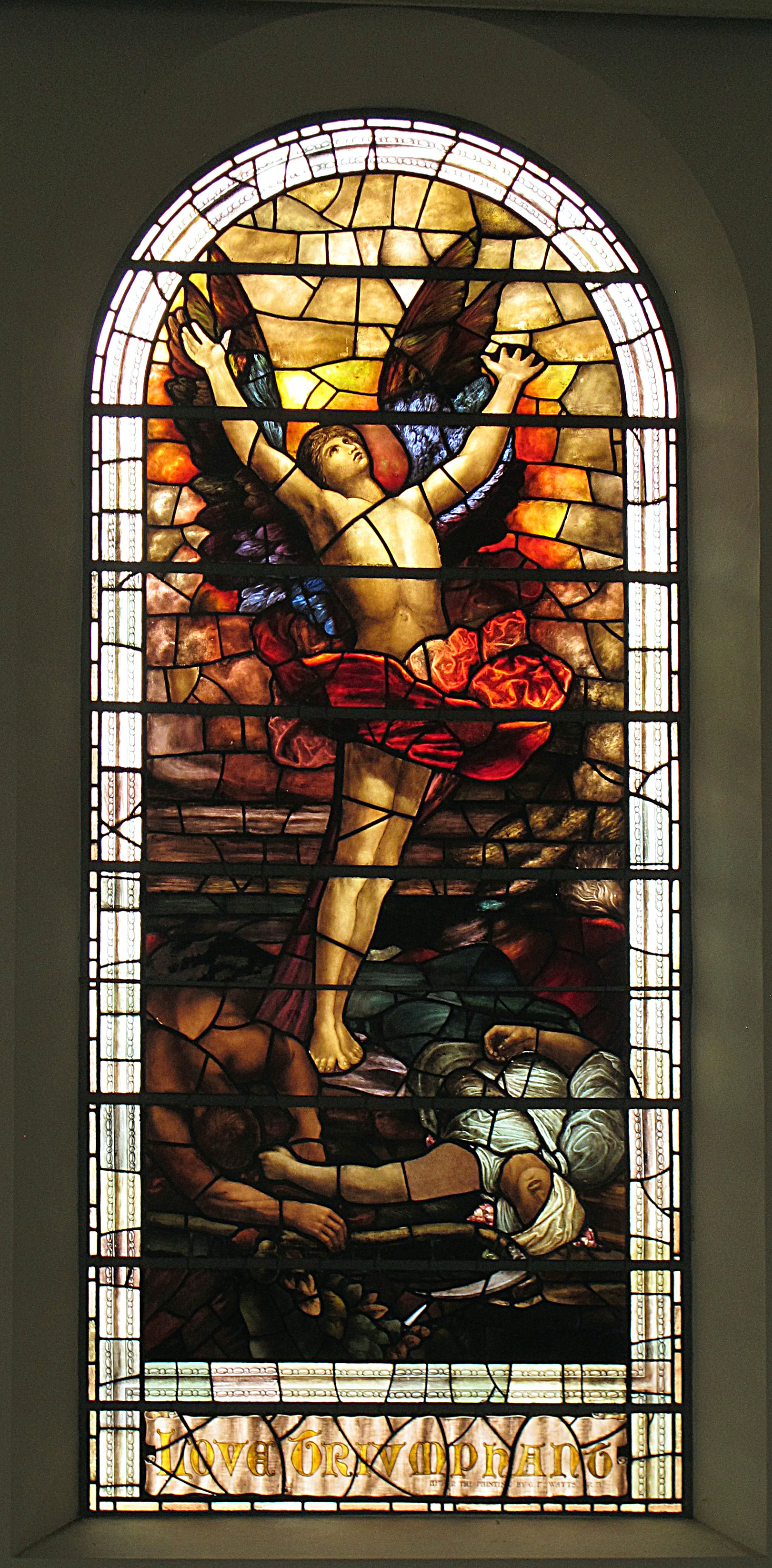
- 1914-18 - 250 men and women associated with the church went on active service; 27 did not return. Their names are listed on the plaque beneath the stained glass memorial window in the Sanctuary. Click here for interactive map showing the cemeteries and memorials where the 27 men of Kingston Congregational Church, who were killed in WW1, are buried or commemorated. A book has been written about these men (2015): 'We will remember them' - the men from Kingston Congregational Church who died in the Great War 1914-1918. Price:£10 to cover costs. If you would like to buy a copy of the book or you are a descendant of any of the men and would like to share information about them, please contact the authors, Susan Watts and John Fisher, through KURC.
- 1915 - A new hall and classrooms were built. Fundraising was led by Edward Bentall.
- 1918 - Girls' Life Brigade was formed.
- 1920 - Major internal decorations during which the Memorial window and great cross were installed.
- 1938 - Railings, garden and trees were removed from the front of the church.
- 1957 - Membership: 500; morning worship: 200; evening attendance: 350.
- 1963 - The church assumed responsibility for Tudor Hall Sunday School.
- 1971 - Inauguration of the Local Ecumenical Partnership (LEP) with All Saints and Kingston Baptist Church. The LEP pledged 'not to do anything separately that ought to be done together.'
- 1972 - The United Reformed Church was formed nationally of the union of the Congregational and Presbyterian churches. A church minibus was bought with 1230 Green Shield Stamp books.
- 1975-7 - The Church Halls were completely rebuilt and the church Sanctuary refurbished. Meantime, church services were held at Kingston Grammar School and Grove Crescent URC.
- 1984 - Grove Crescent URC was integrated with Kingston URC.
- 1991 - The Local Ecumenical Project formalised the Local Ecumenical Partnership.
- 1999 - Plans for a new lift and redevelopment of the Foyer were drawn up.
- 2005 - Richard Mayo Centre re-opened with redeveloped Foyer, lift and Training Room. Sanctuary redecorated following major roof repairs.
- 2012 - 350th anniversary of the publication of the The Book of Common Prayer, and the subsequent 'Great Ejection'.
- (top)
- (top)
- (top)
History of the Girls' and Boys' Brigades in our church
A Boys' Brigade Company (9th Kingston Company) was established at our church in 1906 for boys from 12 - 18 years old and the Girls' Brigade company began in 1918. Both companies were disbanded in July 2011.The Boys' Brigade
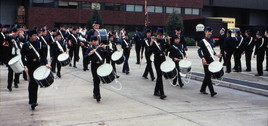 The Boys' Brigade was founded by William Alexander Smith in Glasgow in 1883 as the first national Christian Youth organization whose activities were spiritual, physical, educational and service-related.
The Boys' Brigade motto: 'Sure and Stedfast' seen on the anchor comes from the bible and is a quote from Hebrews Chapter 6 verse19 : 'which hope we have as an anchor of the soul, both sure and stedfast, and which entereth into that within the veil'. The spelling of 'stedfast' has been modernised in recent years and it now often appears as 'steadfast'.
Aim: 'The advancement of Christ's Kingdom amongst boys'.
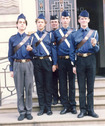
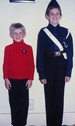 The first captain, Percy Long was followed by a number of long-serving leaders, notably W Johnston, father of Janette Troy who is a current member of our church, and who ran the BB at Kingston URC/Congregational church for many years. He served for 27 years, both locally and on the BB National Executive.
In 1932, the Life Boys (later to become the Junior Section for boys of 9 - 12 years old, and the Anchor Boys for boys of 6 - 8 years old) were also started.
In its heyday, Kingston's Congregational Church Boys' Brigade (forerunner of the present URC) had over 100 members, and 10 leaders. 50 boys used to go to Summer Camp.
The Girls' Brigade
 The Girls' Brigade, originally named the Girls' Life Brigade, was founded in Ireland in 1893.
The Girls' Brigade motto: 'Seek, serve and follow Christ'.
The Girls' Brigade, originally named the Girls' Life Brigade, was founded in Ireland in 1893.
The Girls' Brigade motto: 'Seek, serve and follow Christ'.
Aim: 'To help girls to become followers of the Lord Jesus Christ and through self control, reverence and a senses of responsibility to find true enrichment of life'.
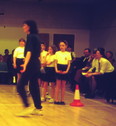 The first Captain of our Girls' Brigade Company (3rd Kingston) was Phoebe Mills. The first member on the register was Lilian Slatter who continued to be involved with the company throughout her long life.
Margaret Golding (a present church member) was the Captain of the Girls' Brigade for 35 years until 1998 during which time the company had between 40 and 50 girls on the roll.
In earlier years, the activities of the Brigades included worship, bible class, parade night, band practice, outdoor activities with a summer camp, fund-raising, first aid, gymnastics, and there was a class of some sort every night of the week.
The final ten years
In 2001, as numbers of children and leaders declined, our Boys' and Girls' Brigades were combined and many of the activities were continued.
In 2006, the Brigade here celebrated its Centenary and ex-members attended from as far afield as Toronto, Seattle and Ottawa.
In 2008 the Boys' Brigade celebrated its 125th Anniversary. Locally we attended a special day at Chatham Dockyard where bands and gymnastic teams performed. An adventure/outward bound weekend was arranged for the older members and the Anchor Boys and Juniors attended a special birthday party with magician, party games, balloons and more jelly than you could possibly imagine!
At the June 2011 church meeting it was formally decided to close the GB and BB companies at KURC and replace them, in September 2011, with the URC Pilots organization.
On Sunday 24th July 2011 a service of commemoration was held and the laying up of the colours of the Brigades took place. The service was preceded by tea and many people who were associated with the Brigades during their long history at this church came to share news and reminiscences.